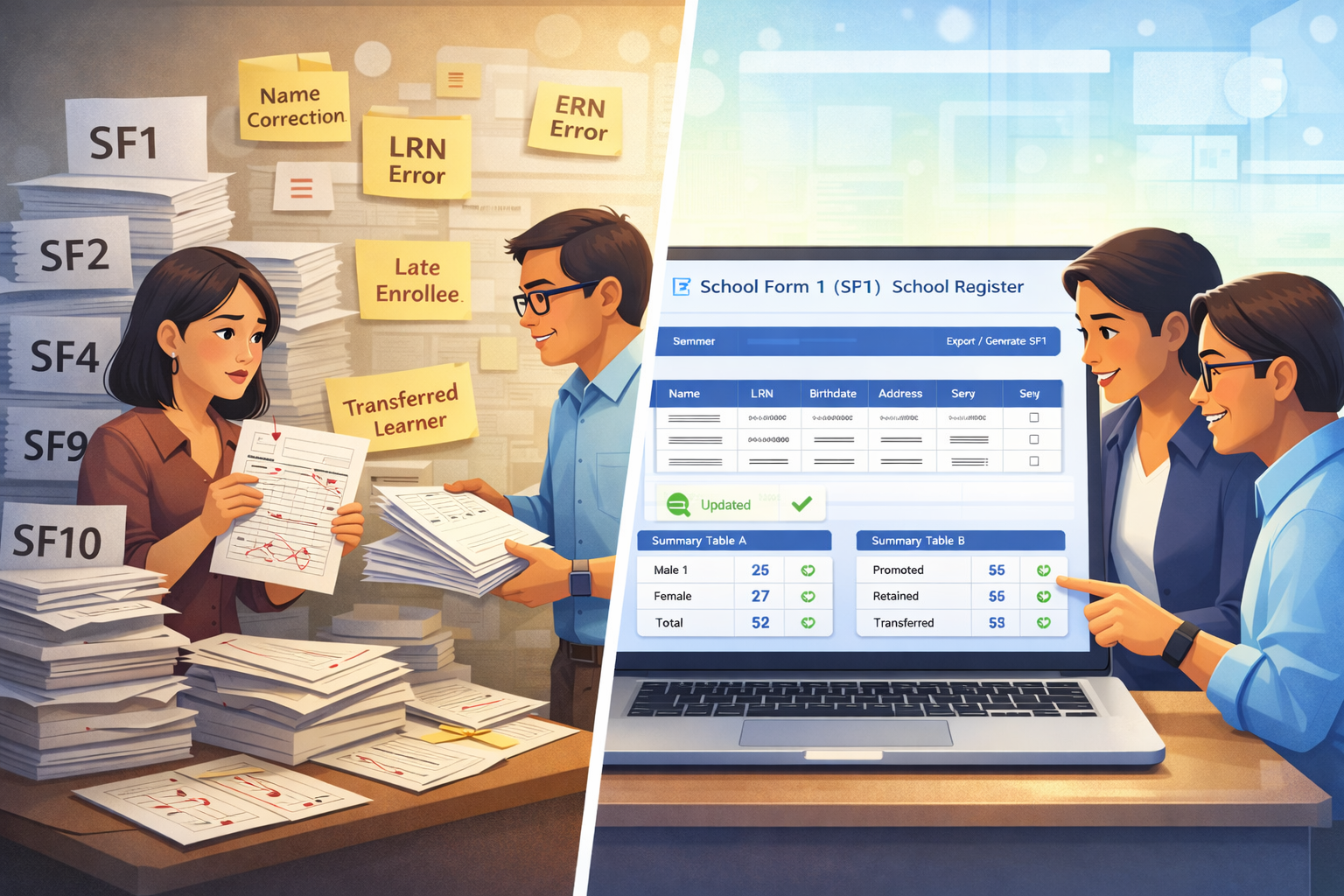
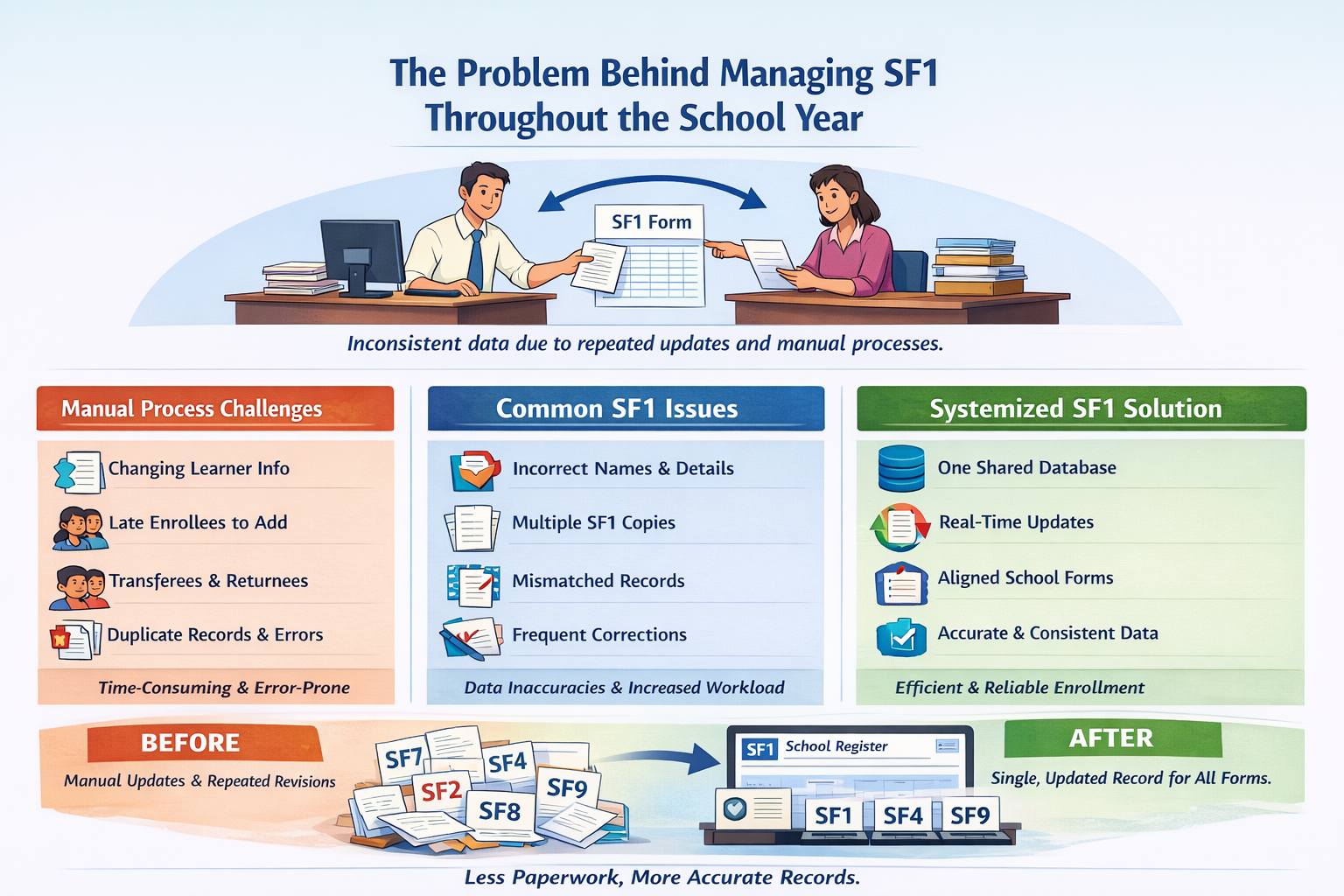
SF1 is often treated as a one-time enrollment requirement, but in real classroom settings, it becomes an ongoing task that extends far beyond the opening weeks of school. Learner information continues to change, and each update requires careful attention because SF1 serves as the foundation for many other school records. When enrollment data is handled manually, teachers must repeatedly ensure that the same information remains accurate wherever it appears. Over time, this creates additional workload that is not always visible at the start of the school year.
Common Classroom Pain Points When Managing SF1
- Correcting incorrect learner information
Misspelled names, incorrect birthdates, or wrong LRNs require reopening the enrollment register and validating the same details across other records.
- Adding late enrollees after classes have started
New learners must be inserted into an already established SF1, increasing the chance of inconsistencies with attendance and grading records.
- Updating records for transferees and returning learners
Learner movement during the school year requires continuous enrollment updates, not just initial encoding.
- Repeating the same learner data in multiple school forms
Enrollment information is manually re-entered in attendance reports, class records, and report cards.
- Risk of mismatched learner details across records
A correction made in SF1 may not be reflected immediately in other school forms, leading to validation issues later.
- Time spent rechecking enrollment data instead of instructional work
Teachers spend additional time verifying enrollment accuracy rather than focusing on classroom responsibilities.
Paperwork & Compliance Overview

Purpose of This Section
This section provides an overall view of how Better Teaching Solutions (BTS) supports the preparation and maintenance of DepEd-required School Forms (SF1–SF10).
It explains how learner records, attendance, and academic data are organized inside the system, and how these records are used to generate School Forms that are consistent, accurate, and ready for monitoring and audit.
Teachers may use this section as a reference to understand how the system works across the school year.
DepEd School Forms in Actual Practice
Under DepEd guidelines, teachers—particularly class advisers—are required to prepare and maintain multiple closely related School Forms. These include enrollment records, attendance reports, academic reports, and summary forms.
In a manual setup, these forms are often handled separately. Over time, this leads to common issues such as:
- Repeated encoding of the same learner information,
- difficulty updating records when learner status changes,
- inconsistent totals across related forms, and
- increased workload during submission and audit periods.
These challenges occur not because teachers fail to comply, but because School Forms rely on the same learner data being entered and checked multiple times.
How does BTS align with DepEd Requirements?
BTS is designed to align with the structure of DepEd School Forms.
Instead of treating each School Form as an independent document, BTS organizes all learner-related information under a centralized learner record. From this record, School Forms are generated and kept aligned.
When enrollment details, attendance, or academic records are updated, the changes are reflected across all related forms that use the same data. This reduces the need for manual cross-checking and repeated corrections.
BTS does not modify DepEd forms or reporting requirements. It supports them by ensuring that the required data remains consistent across all forms.
Core BTS Features

Centralized Learner Records
Each learner has a single record that contains enrollment details, attendance data, and academic information. This record serves as the reference point for all School Forms.
Shared Data Across School Forms
SF1, SF2, SF4, SF5, SF6, SF9, and SF10 draw from the same learner data, ensuring alignment of counts, names, and records.
Automatic Alignment of Totals and Counts
Learner totals in enrollment, attendance, promotion, and summary forms remain consistent because they are based on the same data source.
Data Consistency and Validation
The system checks for common issues, such as mismatched learner counts, incomplete records, and inconsistencies across related forms, before finalization.
Audit-Ready Organization
School Forms are organized in a manner consistent with DepEd monitoring and audit processes, reducing the need for last-minute corrections.
DepEd School Forms Covered

BTS supports the preparation and maintenance of the following official DepEd School Forms:
SF1 – School Enrollment Register
- Official list of enrolled learners and basic learner information.
SF2 – Daily Attendance Report
- Daily attendance record of enrolled learners.
SF3 – Book Inventory
- Record of textbooks and learning materials issued and returned.
SF4 – Monthly Learner Movement and Attendance
- Monthly summary of attendance, transfers, dropouts, and late enrollees.
SF5 – Promotion and Retention Report
- End-of-school-year learner status.
SF6 – School Summary Report
- Consolidated summary of enrollment and learner movement.
SF9 – Learner Progress Report Card
- Quarterly academic performance of learners.
SF10 – Learner Permanent Academic Record
- Permanent academic history of learners across grade levels.
Data Consistency and Validation
- Ensures alignment of learner data across all applicable School Forms.
System Use Across the School Year
Throughout the school year, learner data is updated as needed due to enrollment changes, attendance records, grading periods, and learner movement. Because School Forms in BTS are connected through shared data, updates are reflected consistently without repeated encoding.
This is especially important during:
- enrollment and early school-year adjustments,
- quarterly grading and SF9 preparation,
- end-of-year promotion and summary reporting, and
- school and division audits.
What This Means for Teachers
Using BTS reduces the time spent encoding, rechecking, and correcting School Forms. Records remain consistent across required reports, and preparation for submission and audit becomes more manageable.
BTS supports compliance with DepEd requirements by simplifying the preparation and maintenance of School Forms.
Summary
BTS covers all required DepEd School Forms, centralizes learner data, and helps ensure accuracy and consistency across reports. It is designed to help teachers meet documentation requirements efficiently and with a lower risk of errors.
Author
Better Teaching Solutions
Making teaching easier, giving more time for our hard working teachers!